Consciousness – Vedanta view and modern psychologist view
Consciousness – Vedanta view and modern psychologist view The Vedantas or Upanishads describe four levels of consciousness: Conscious, Subconscious, Unconscious, and Super Conscious. The first is the jagratha (Waking stage, Consciousness) which is known as the Vaisvanara, in this state the individual gains experience from the external world. The second is the prajna (Deep sleep, Sub consciousness), in this the Atma has retrieved itself into dreams away from the external world. The third is the susupti (Deep Sleep, Unconsciousness), here all the desires are gone and the individual is not dreaming. It is the state of Prajna. The practice of A-kara, U-kara and M=kara is used to signify the state respectively. Combining the three (Turiya) signified by the Om-kara is the union of the atman to Brahaman moving into the final stage of conscious the Super-consciousness. The Psychoanalytical field of Psychology developed by Sigmund Freud predominantly describes three levels of consciousness. The image below describes his theory: The conscious mind consists of an individual thoughts and perceptions, this is what is immediately accessible to the individual. The Preconscious Mind consists of memories and stored knowledge. Things that are right outside the conscious awareness but can I e brought track to awareness by recall. Finally, the Unconscious Mind, it consists of all sorts of significant and disturbing material which we need to keep out of awareness because they are too threatening to acknowledge fully. These contain shameful memories, undesirable thoughts, and motives etc. While there is another phenomenon called the Subconscious Mind. The subconscious mind is often interchangeably used for the Preconscious mind. However, the subconscious mind is a secondary mind system that regulates everything in our life. It is part of our consciousness process that is not actively in focal awareness. While some theorists believe the unconscious mind is a bigger domain that consists of froth the preconscious and the unconscious mind.
Consciousness and application of respective hatha yoga practice
Consciousness and application of respective hatha yoga practice, to each layer of consciousness – mandukya upanishad. The first is the Jagratha (Walking stage, Consciousness) which is known as the Vaisvanara, in this state the individual gains experience from the external world. Vaisvanara is important for the practice of asana and pranayama as it requires the conscious experience of the external and the internal body. The second is the Swapna (Deep sleep, Subconsciousness), in this the Atma has retrieved itself into dreams away from the external world. It is withdrawal of the atman, this can toe practiced through Yoga Nidra, and Ajapa japa. The third is the Susupti (Deep Sleep, Unconsciousness), here at the desires are gone. To reach the state of Prajna, the individual should be at be to practice Dhyana or meditation, withdrawing all desires and fluctuations of mind. This will eventually lead to the knowledge of Paper consciousness and attaining it.
108 Upanishads listed by Muktikopanishad
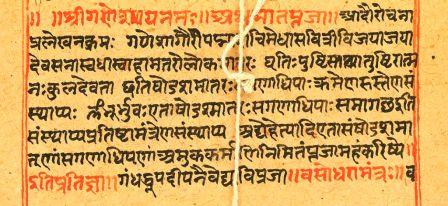
Rig Veda: Aitareya Upanishad Atmabodha Upanishad Kaushitaki Upanishad Mudgala Upanishad Nirvana Upanishad Nadabindu Upanishad Akshamaya Upanishad Tripura Upanishad Bahvruka Upanishad Saubhagyalakshmi Upanishad Sama Veda: Kena Upanishad Chandogya Upanishad Mahat Upanishad Maitrayani Upanishad Vajrasuci Upanishad Savitri Upanishad Aruneya Upanishad Kundika Upanishad Maitreyi Upanishad Samnyasa Upanishad Jabaladarsana Upanishad Yogachudamani Upanishad Avyakta Upanishad Vasudeva Upanishad Jabali Upanishad Rudrakshajabala Upanishad Yajur Veda: Katha Upanishad Taittiriya Upanishad Isavasya Upanishad Brihadaranyaka Upanishad Akshi Upanishad Ekakshara Upanishad Garbha Upanishad Prnagnihotra Upanishad Svetasvatara Upanishad Sariraka Upanishad Sukarahasya Upanishad Skanda Upanishad Sarvasara Upanishad Adhyatma Upanishad Niralamba Upanishad Paingala Upanishad Mantrika Upanishad Muktika Upanishad Subala Upanishad Avadhuta Upanishad Katharudra Upanishad Brahma Upanishad Jabala Upanishad Turiyatita Upanishad Paramahamsa Upanishad Bhikshuka Upanishad Yajnavalkya Upanishad Satyayani Upanishad Amrtanada Upanishad Amrtabindu Upanishad Kshurika Upanishad Tejobindu Upanishad Dhyanabindu Upanishad Brahmavidya Upanishad YogakundalinI Upanishad Yogatattva Upanishad Yogasikha Upanishad Varaha Upanishad Advayataraka Upanishad Trisikhibrahmana Upanishad Mandalabrahmana Upanishad Hamsa Upanishad Kalisantaraaa Upanishad Narayana Upanishad Tarasara Upanishad Kalagnirudra Upanishad Dakshinamurti Upanishad Pancabrahma Upanishad Rudrahrdaya Upanishad SarasvatIrahasya Upanishad Atharva Veda: Prasna Upanishad Mandukya Upanishad Mundaka Upanishad Atma Upanishad Surya Upanishad Narada-Parivrajakas Upanishad Parabrahma Upanishad Paramahamsa-Parivrajakas Upanishad Pasupatha-Brahma Upanishad Mahavakya Upanishad Sandilya Upanishad Krishna Upanishad Garuda Upanishad Gopalatapani Upanishad Tripadavibhuti-mahnarayana Upanishad Dattatreya Upanishad Kaivalya Upanishad NrsimhatapanI Upanishad Ramatapani Upanishad Ramarahasya Upanishad HayagrIva Upanishad Atharvasikha Upanishad Atharvasira Upanishad Ganapati Upanishad Brhajjabala Upanishad Bhasmajabala Upanishad Sarabha Upanishad Annapurna Upanishad Tripuratapan Upanishad Devi Upanishad Bhavana Upanishad Sita Upanishad
Eka Pada Setu Bandha Sarvangasana(One legged Bridge Pose)
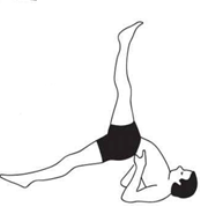
This is a variation of the bridge pose where you raise one leg into the air. You must start by lying on the ground. Bend the knees and place them with the feet on the floor and the knees pointing to the ceiling. Raise the back off the floor with the shoulders and head still on the ground. Support your back by placing your palms on it. Try and straighten your legs so they are stretched out with your legs together. From here, raise the right leg vertically in the air so that it is perpendicular to the floor. Stay here breathing easily for thirty seconds and then lower back down. Repeat this with the other leg. Precaution: Benefits: The pelvic region benefits from this exercise and the hamstring muscles are properly toned. The asana also relieves backaches and prevents the development of hernia.
Yoga as a Science of 4 States of Human Consciousness
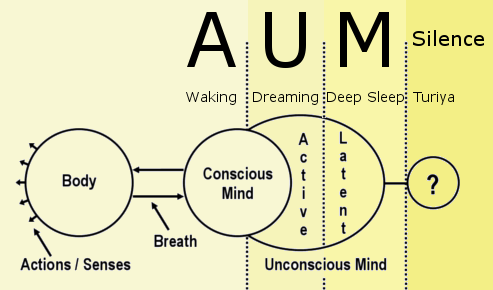
The Mandukya Upanishad deals with the four states of consciousness. Waking, 2. dreaming, 3. Deep sleep and 4. Turiya or samadhi state. It also states that everything in the universe is OM and that the past, present and future are contained in OM. The three components or syllables comprise the three states of Brahman. After meditation on OM one is taken to the silence which is Atman or Brahman.
Katha Upanishad(A Dialogue with the God of Death – What Happens to the Soul after Death)
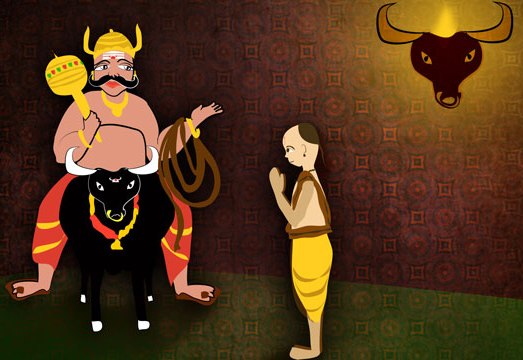
There was a sage Vajasrava who was performing a yajna. After the Yagna his son Nachiketa was bothering him and so the sage banished him to hell where Nachiketa found himself in the domain of Yama, the Lord of Death. Nachiketa waited three days in front of Yama’s house and for this Yama granted him three boons. For this first boon Nachiketa asked for his father’s welfare and that when he went back to his father, his father would recognise him and be happy with him. This was granted. For this second boon Nachiketa asked to know how to reach heaven and Yama gave him the knowledge he had requested. He told Nachiketa between Preyas (worldly pleasure) and shreyas (spiritual good), the latter which can give permanent peace and happiness and that Atman is the highest form of shreyas. For his third boon Nachiketa wanted to know what is beyond good and evil, cause and effect. Here he learned that OM is the symbol of the omniscient self, and this self dwells within all. Yama also declared that one’s destiny after death is decided by his karma in life. One who realizes this becomes immortal. Brahman is the end of the journey and the supreme goal. The whole universe comes forth from Brahman and moves into Brahman. When all the senses are stilled and the mind is at rest, this is the highest state, called yoga. He who attains this is free from delusions and is pure and impartial.